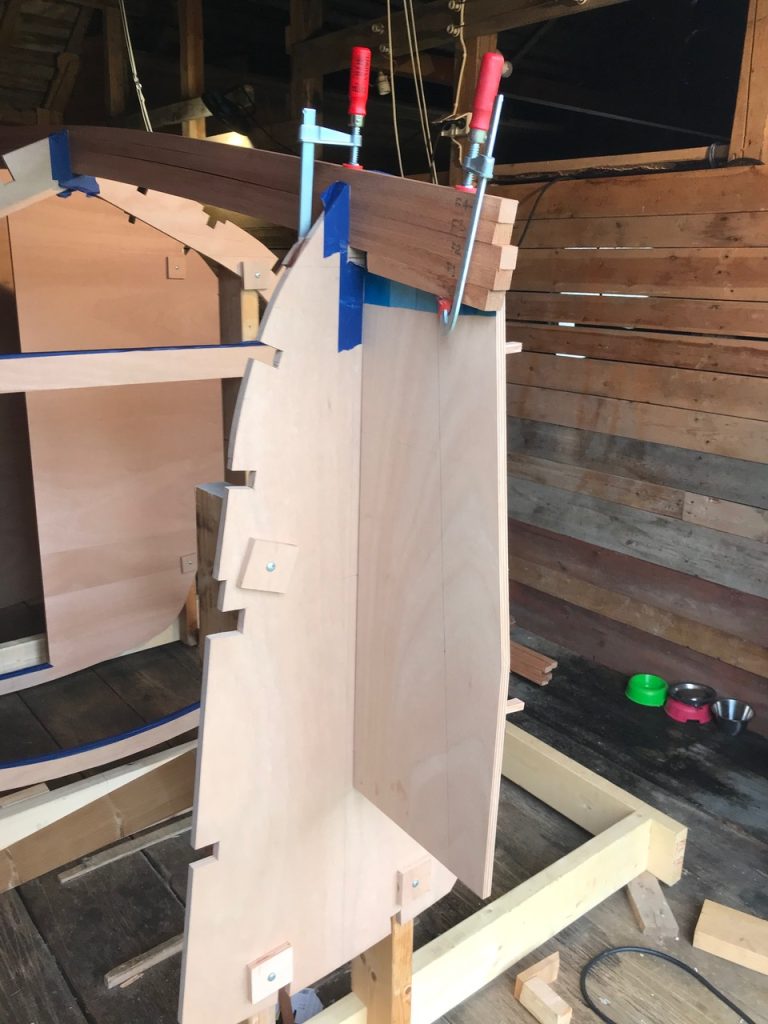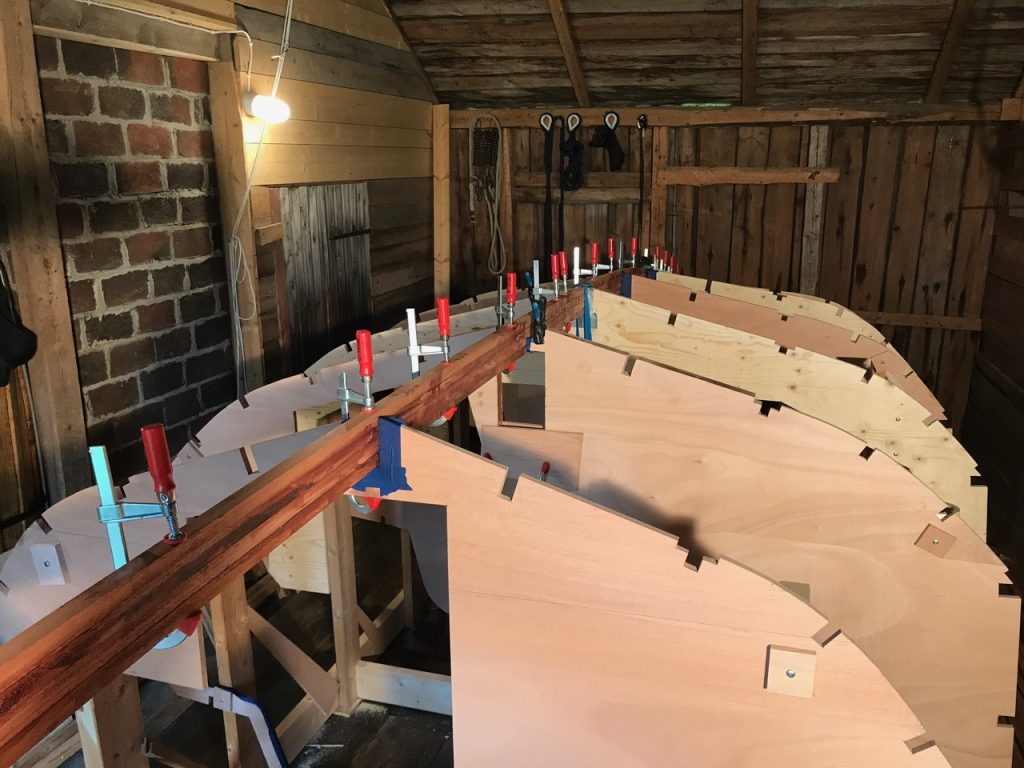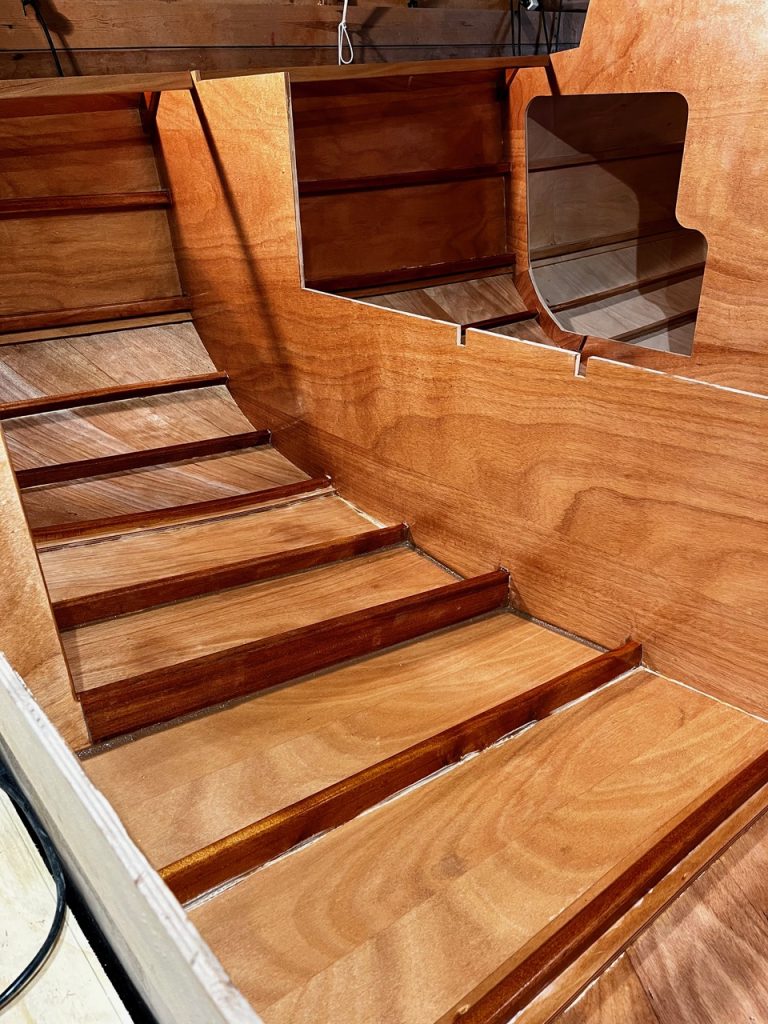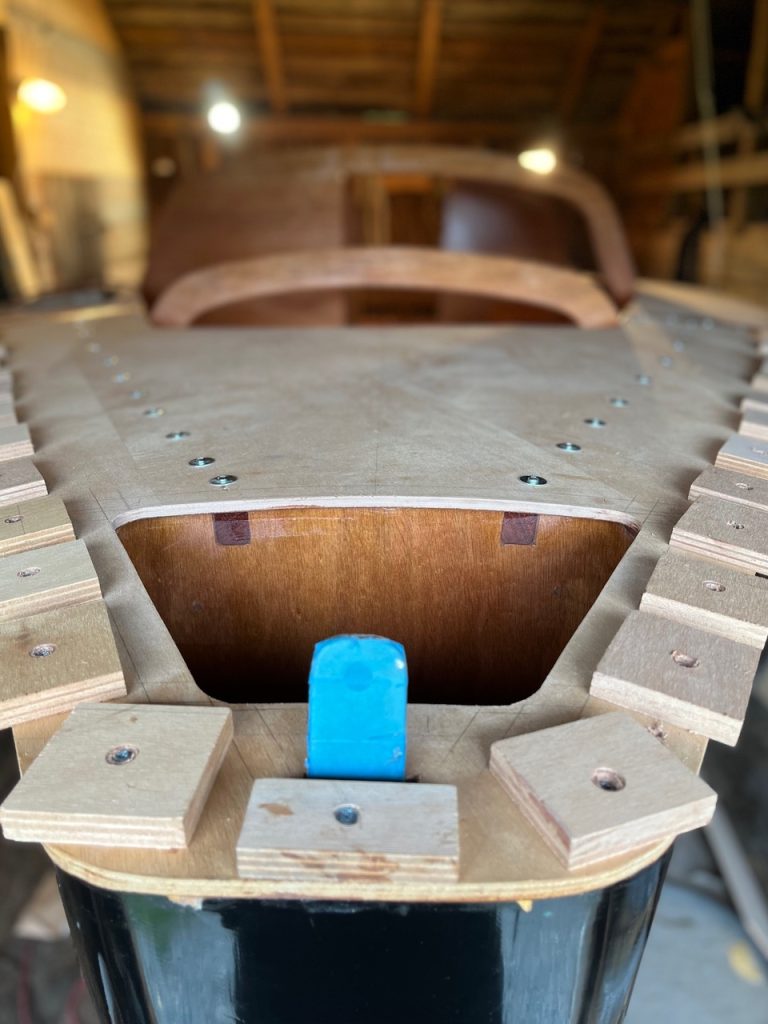


Fredrick and his mates bought the IDEA21 plans about 4 years ago; as I normally do when I see a new order, the first thing I did was to check in which corner of the world I was going to send the plans; in this case it was a really peculiar place, the gulf of Botnia, between Finland and Sweden, about 65° north, by far the most northern set of plans I have ever sent!
An Arctic IDEA21 !
I followed their building process via instagram, you can find them at https://www.instagram.com/fredrikpantze/ and https://www.instagram.com/mycklekajakvarv/ ; it was absolutely fascinating to see the boat take birth in a barn surrounded by snow in the glowing light of northern seasons, watching them building the small parts (rudders, beams) within the house during the winter, because working with resins during the winter in the cold of the barn was clearly impossible.
Their amazing boat was launched this August, and about a week ago I started writing a post about this building, and then I thought about asking directly to the builders about their adventure; and so here we are , after this short introduction I will let Fredrick speak ; I will only add short comments at the end of each paragraph, featuring an italian lettering to make them clearly distinguishable from the original comments.

”This is my first whiskey plank this year. How about you?”
I couldn’t help but smile while listening to my friends trying to blend into this unusual gathering — celebrating the installation of the last wooden plank on the hull. It was exactly one year after the build had started, in the summer of 2020. In a way, we were all beginners in the art and process of boat building.
For me, my daytime job is in IT, with no formal education in woodworking or boatbuilding. Back in 2015, a colleague asked if we should each build a wooden sea kayak. He had read something about strip-built kayaks made with epoxy and fiberglass. My immediate response was, “Sure, how hard can it be?” 🙂. It took twice as long as anticipated but it provided some experience with wood, epoxy and fiberglass work. I have always been curios and eager to dive in.
To gain a little bit of experience building a small dinghy or a kayak is a good idea before diving into a bigger project, but it not strictly required to build a wood & epoxy boat.
Why did I choose the Idea21?
The last boat we owned was a 39-foot Najad from the 1980s — perfect for the family (once you managed to get everyone on board). But I wanted something smaller, with fewer systems that could fail, and without the massive effort of hauling a 10-ton boat in and out of the water every season. I dreamed of building my own boat — one that was trailerable and easy to handle. Keep it simple.
For a long time, I was looking into more classic designs, like the Cape Henry 21. But after watching countless Volvo Ocean Races and Vendée Globes, I started craving a more modern hull shape. By chance, I stumbled upon a video by Michele Manconi sailing an Idea 19 — and it looked like pure fun!
the purpose of creating building plans like idea19 first, and idea 21 following, was exactly this: to provide plans of a small , affordable , fun and fast sportboat that can be buld by a newbye builder.
What mistakes did I make?
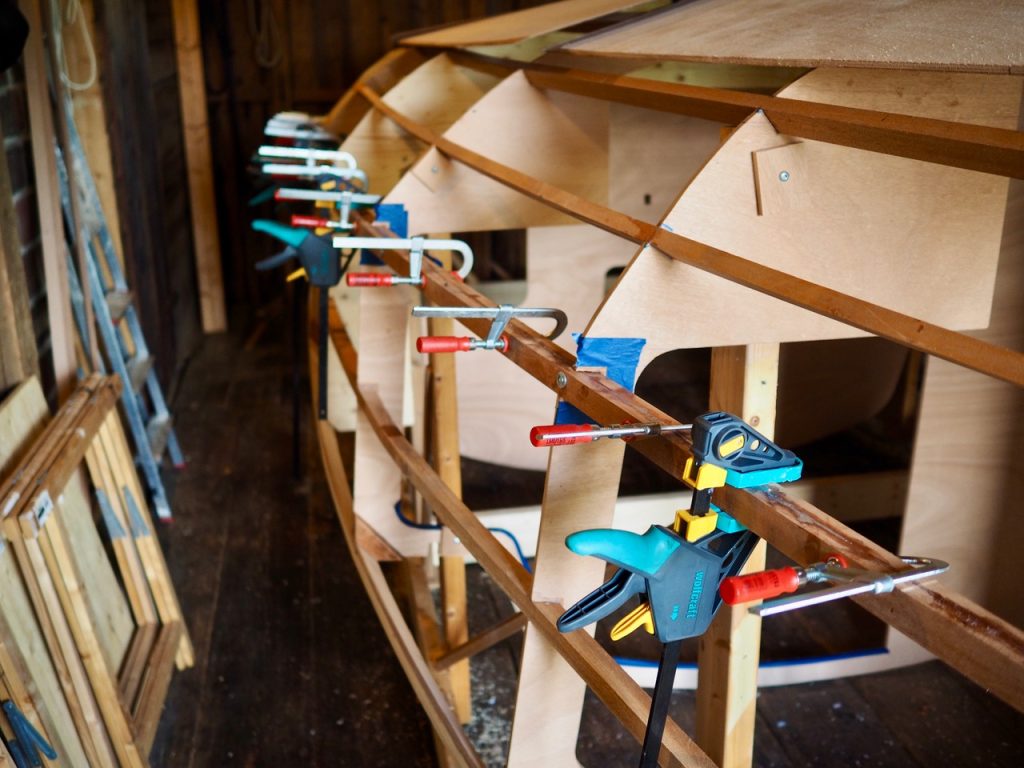
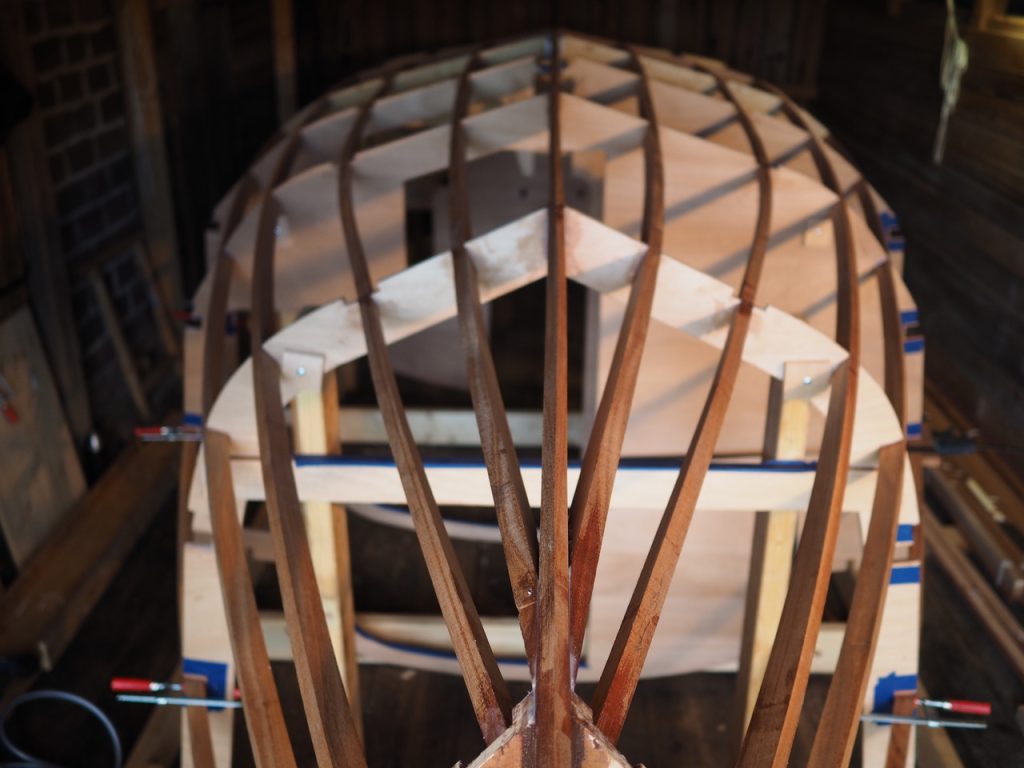
The first major setback came when installing the chine stringers on the hull. The chine stringers are larger than the others (30×40 mm), and bending a solid mahogany piece to the shape of the hull caused one of them to snap in two. Looking back, that was an obvious outcome. It should either have been steam-bent or laminated from two 30×20 mm pieces. I went with the latter solution.
The assembly scaffold is really sturdy for holding the bulkheads in place during installation of the stringers. However, I failed to maintain the proper shape of bulkhead number 4. It’s particularly sensitive since it has the interior wall for the head on the starboard side and a full opening on the other, making it easy for the plywood to bend. I discovered this only after the hull had been turned, and I had to detach it from the stringers to realign it properly.
this kind of feedbacks are extremely useful for me, we discussed the same issue with other builders and I upgraded the plans accordingly. That’s what normally happens for each boat built. I try to figure out every possible issue while writing the plans but I cannot master the 100% of the potential small issues like this. As long as the issues are of these size it’s not a big drama.
Handling epoxy is a dark art — especially in colder climates. Just when you think you’ve mastered it, a new challenge appears. During the final stages of the hull, in a cold and humid autumn, I ended up with amine blush all over the surface. At first, I didn’t know what it was, so I ended up cleaning the entire hull with warm water and a sponge.
The latest issue appeared when the boat was taken out of the water. I found a crack or delamination along the trailing edge of the keel. During shaping, I had accidentally removed too much fiberglass, leaving parts of the wooden core exposed. I missed this during the build, but it was obvious later since the wood itself had paint on it. I should have applied more fiberglass and made sure it also wrapped around the trailing edge of the keel — not just the leading edge.
This was also my first time using heavier fiberglass cloths, and it became clear that I had used far too little epoxy. (There are some great articles by Christian showing a method to fully saturate the fiberglass, which I followed in later stages of the build.)
the epoxy & fiberglass works are the steepest part of the learning curve for a DIY boatbuilder, so I decided to write a little bag of tricks derived from my own experience as a boat builder and composite builder, you can find them in the blog section, it’s not the bible, but these are first hand tested tricks that can help cutting some corners and avoiding annoying mistakes.
Biggest learnings?
My biggest learning has been to accept what is good enough. There’s no end to chasing perfection. At some point, you just have to stop, accept, and move on.
I also learned, after several mishaps, to take a break before tackling a critical part of the build. Once all the preparations and measurements were done, I’d take a coffee break or call it a day. Coming back with a fresh mind helped me double-check my assumptions and catch potential mistakes.
This is probably the most important lesson to take away: perfection do not exist, the builder will be the only person to see the 95% of the “mistakes” he did on the boat, I can guarantee that this is true for both DIY builders and professionals ; I can make an exact list of all the “mistakes” I did in my career when I worked on big boats in a boatyard as a professional, mistakes that nobody has ever noticed. Flawless boats simply do not exist and you will reach a point where you have to invest a HUGE amount of working hours to gain a marginal (and pointless) gain in the construction quality. That’s the point to advance and go on in the bulding process.
In the end, what went well?
Early on, I invested time in preparing my workspace — making it functional and a nice place to be. That effort paid off during the countless hours spent there.
I also learned to limit the amount of work in progress. Don’t rush. Focus on one task at a time and finish it before moving on. It’s deeply satisfying.
Lastly, I decided to reduce my working hours to four days a week, dedicating Fridays to boatbuilding. For me, that became a way to recharge and make the whole experience more enjoyable.
Preparation is the 90% of the work, and keeping a steady pace is by far more important than running, building a boat it’s a marathon or a ultratrail run not a speed dash.
Finally, some numbers:
Five years (total of 1800 hours) to get the boat sailing.
The hull was turned and painted after 18 months.
Costs:
Seldén mast: 7 700 EUR
North Sails (Sport Xi Aramid): 5 800 EUR
Fittings (Allen) and Lines (Marlow): 5 100 EUR
Mahogny and Plywood: 7 600 EUR
Led keel: 3 700 EUR
Epoxy: 3 500 EUR
Making a total cost of 42 000 EUR
This note will be a little bit longer than the previous ones, budget is a really important subject so I want to spend several words on it;
42k euros is a big amount of money: to make a comparison a brand new glassfiber 22-24 footer is about 80-85k euros ; unfortunately there is a very small amount of small boats being made today by boatyards , so a comparison with a commercial boat can be hardly made; the “entry level” of sailboats for the market is becoming a 33 footer, which by the way for me is totally crazy; Let us plit a little bit the grand total into the single voices ; it is easy to see that roughly a third of the total is made by rig and sails.
Unfortunately rig and sails for small sportboats are disproportionally expensive, and Frederick choose to go for a top quality choice for both rig and sails. This the reason that pushed me to include a wooden rig option in idea21 plans, if you to spent a little bit of extra work and you are not interested a top performances rig (mostly in terms of weigth) you can decide to build you own wooden rig and save probably the 60-70% of those 7700 euros.
Similar approach for the sails, you can save around the 40-50% of 5800€ switching from a laminate top notch sails by a sper renown sailmkaer like North Sails (I choice that I personally love , money spent in very good sails are always fine for me) to a good quality dacron cross-cut set of sails perfect for cruising; it’s a personal choice. Others voices are hard to lower, plywood has skyrocketed in the last years, so did epoxy, lead for the keel can be harvested with a little bit of difficulty from plumbers that make refurbishing works on old houses (at least here in italy) but it’s every year more difficult. You can choose to simplify a little bit the deck hardware but in this process you have to pay attention to make several manoveurs more complicated or tricky.
But the most important voices of the budget is not explicited in this calculations: it’ the value that you give to the time you are going to pour into this enterprise; the advice it’s always the same since I began to work with homebuilders, about twenty years ago: if you put a positive value in the process of making a boat with your hands , the entire building process has a meaning and it’s worth thew effort, if bulding a boat is only a shortcut to keep the budget low, but in the end you consider it an annoying process, and you prefer to invest that amount of time in sailing or other activities, my advice is to look for a second hand boat, the market offers for sure something to suite your needs and budget, without the need to get involved in a so messy and time consuming process like building your own boat.
Thanks a lot to Fredrick for sharing its building experience. I will close this post with several pictures testyfing the quality of the building.