

affordability for DIY builders starts from the drawing board
I am currently developing a new project, that will see the light hopefully in the spring-summer 2026 ; it’s a modern sleek looking sporty cruising sailboat in the 30 footer range.
I decided to take a design approach that will pay a good amount of attention to keep the budget affordable from the first steps of the project, so the solutions that I am going to talk about are integrated in the project from the very beginning and they are not a kind of bandaid applied at the end of the project; the main areas in which I am working to reach this goal are:
- outboard engine encased in a locker near the transom: the current price of a small inboard diesel engine fitted with a saildrive transmission, the typical solution for small sailboats, is about 13k euros vat included , and to these not cheap amount of money you have to add the ancillary systems: exhaust, the GRP saddle to mount it on board, a dedicated battery , sea water intake circuit for cooling, etc. etc. A modern four stroke outboard engine in the range of 20 hp is about HALF the price, so you can easily save 6.5 k euros ( even more considering all the aforementioned ancillary systems related to the inboard diesel engine) ; from the strict technical point of view this choice can (and will) raise more than an eyebrow from a lot of purists and serious offshore sailors out there, but in the everyday reality of a DIY small sailboat suited for coastal cruises, daysailing and very occasional short passagemaking, a boat that is perfectly capable of sailing in light air without motoring, this choice in my opinions makes sense; modern 4 strikes outboard engines are reliable, sturdy, have a good torque, several of them have an alternator to charge your batteries when you are motoring, they have electric start, they can be removed from the boat easily to be serviced, and if they work in front of the rudder , steering the boat while mooring will be more or less the same as having an inboard engine; another advantage is that the skills required to an homebuilder to install an outboard engine are near to zero compared to those required to properly install an inboard engine, both with a saildrive or a classical shaft drive transmission.
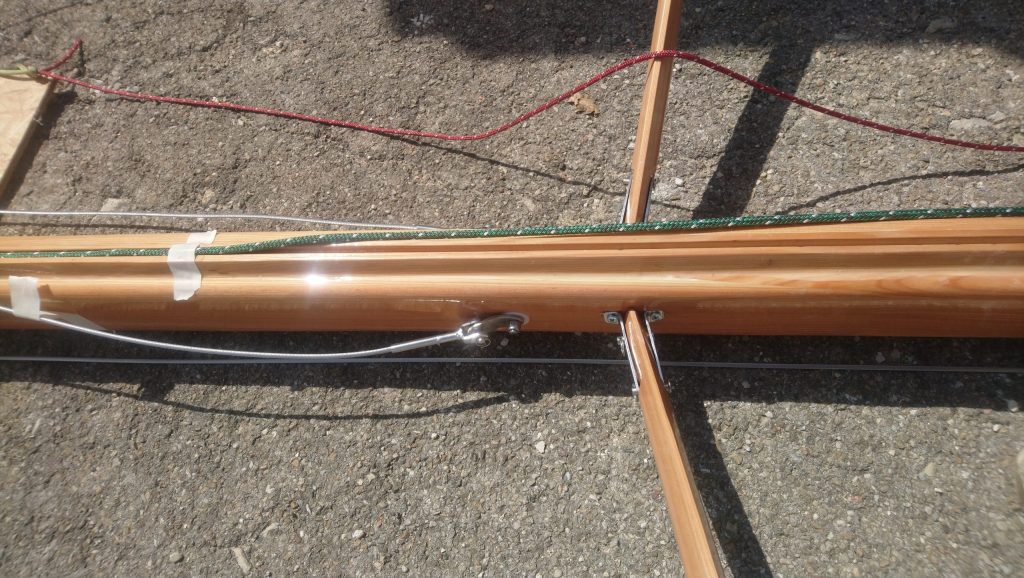
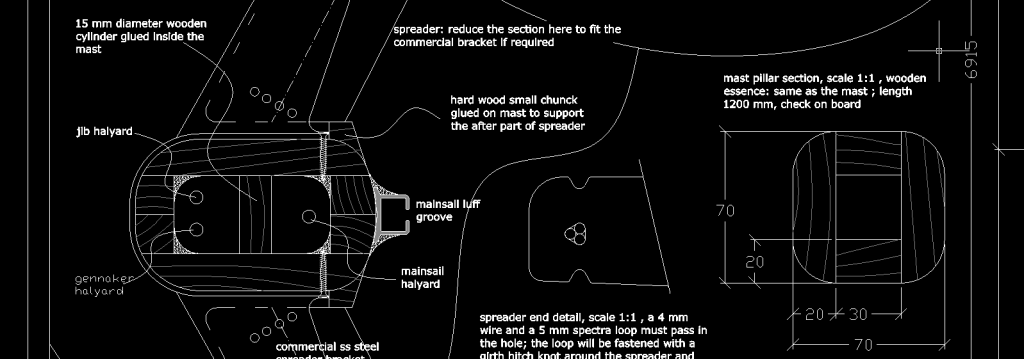
- rig: plans will include two drawings dedicated to the construction of a wooden rig; I followed this path in the past both for idea 21 and haiku 700, and I will include this drawings in all the coming plans of all the sailboats of this size. The aluminum masts for small sailboats are dis-proportionally expensive, I do not even mention the carbon fibre ones, and as long as you don’t have to race the boat at high level, the little bit of extra weight of a wooden mast can be easily tolerated; the current quotation for a complete alloy rig for an idea21 is in the order of 6-7k euros, for a 9 meters boat this can easily jump up to 10-11k euros, which is a big slice of the total budget for projects like these. A DIY made rig for a 24 footer project can easily cost about 2000 euros in raw materials and hardware, and it requires a set of skills that an homebuilder has at 90% already developed during the boat construction process.
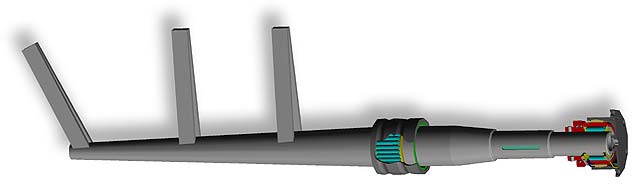
- steering : when you start to design boats in the 30 footer range, you can decide for a “dinghy” style steering tiller on a transom hung rudder, if you have a single rudder, or with the typical setup of single tiller and twin rudders hung on transom like in idea 21 and several other of my plans. Otherwise you can go for a spade rudder under the hull, with or without a steering wheel. The spade rudder is definitely a more efficient solution, the rudder is always perfectly in the water except for really high and undesired heeling angles (normally it happens while broaching in strong winds), its dimensions can be slightly reduced due to its higher efficiency compared to a transom hung rudder, saving a little bit of drag, improving performances under sail. Technically there is no match, the spade rudder wins. From the budget and ease of construction point of view the higher efficiency of a spade ruder steered by a wheel has a really high price. Making a spade rudder means making a ss steel internal structure with a rudder axis milled from ss steel thick stock, do some other metalists works welding the other parts on the stock, make laminate composite sandwiched rudder cheeks (or plywood ones), build the waterproof high load rudder bearings required to set up the rudder in the hull , which has to be bombproof because it is a very critical part of the boat from the navigation safety point of view. Given that, if you decide to have a steering wheel, you have to build all the mechanical gears connecting the wheel to the rudder sector , or purchase all these stuffs ready to be installed (in this case around 7-9k euros will merrily fly away from your wallet to purchase the complete rudder, ball bearings and related stuffs, the wheel with the pedestal and the mechanism to connect it with the rudder); in any case you are going to spend a lot of money , time and add a good amount of mechanical complications to your building process ; that is why, like I did for Hirundo 750, the standard solution for this new project will be a single transom hung rudder with its wooden tiller, simple, strong and easy to build. I also have to point out that in my opinion for a small sporty sailboat in this range of dimensions, a tiller steering is by far the best solution to really feel the boat in our hands. Anyway, if you are interested in this subject Jefa website is a real bible !
Let us crunch some numbers: this technical solutions, compared to the most complex ones that we considered, will allow you to save roughly 15 k euros , which is about the amount of money you will spend for the epoxy resin , glass fabrics and additives to build the whole boat AND for a good set of brand new cruising sails. Not bad at all.